
I was staring at the question, and I literally had the tip-of-the-tongue phenomenon. I knew it was in my memories somewhere, and I could visualize the layout of the page, but I drew a complete blank on how to actually solve it. So, what was wrong with my brain? Actually, there is nothing wrong with my brain, or yours. You just spend too much time for the preparation step. You think about what you will get if you finish the work, but never actually think deeply about what you should do to complete it more effectively and save time. Today, I would like to introduce to you, yes you, how to take notes and work with social subjects more effectively.
People who take classes, like APUSH, have to remember a huge amount of information, such as dates, events, how they happened, and their effects. Yes, we also have to read a lot of books. As an international student who was not born speaking English, reading in English is challenging. Honestly, history is one of the most boring subjects to me. I could spend a whole day doing math homework rather than reading 15 minutes of an APUSH chapter. So, to help those that struggle as well, here is my notebook and how I organize most of my information:
First, I take some of the key concepts or keywords from that chapter. For example, the key term in Unit 2 of APUSH could be ‘The Navigation Act’ or ‘Neglected Act.’
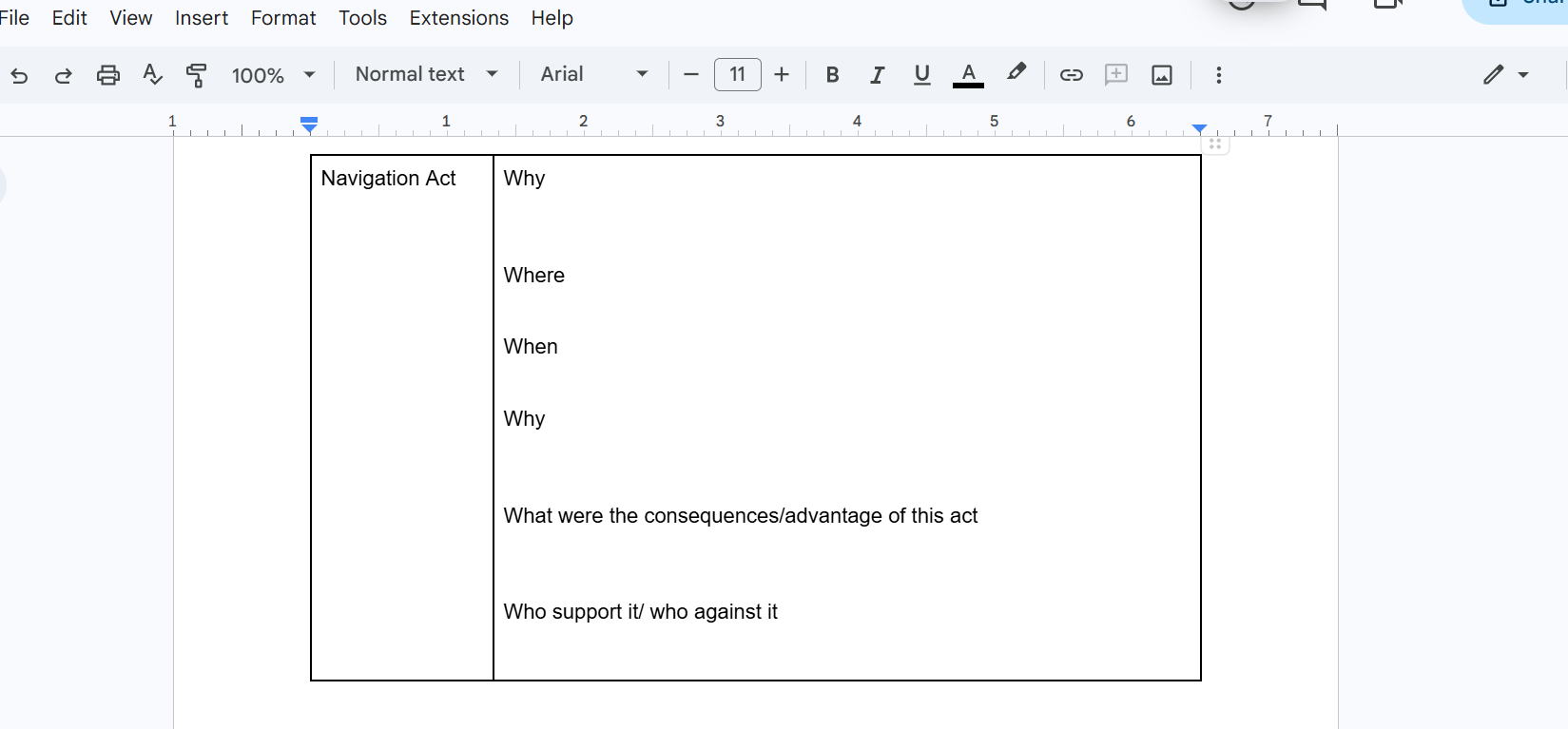
Next, I create a bar chart with 2 columns. One column would be for the key terms and the second column would be for the information about the term, such as what lead to that event, why, when it happened, where, how, and when did they ratify it and abolish it.
In addition, if you’re making science notes, you could make 3 columns instead of 2. Column 1 could be the title, column 2 could be the definition, and the last column could be the examples. It actually depends on what subject you are taking notes for and the main goal of your notes. You have to determine what kind of note you want to take such as a formula-example notes (I usually use this for math or any mathematic subject), term-definition/description notes (for history), or definition-example notes (for biology or languages).